
By Lee Moran, Founder of Veritas Digital
There is a particular kind of message I have started receiving more often and see more regularly popping up on LinkedIn. A business owner, a CMO, or a marketing lead, asking whether they still need PPC management now that AI can “just run the account”. It is a fair question, and the honest answer is more interesting than either the hype or the fear would suggest.
Agentic AI has arrived in Paid Search/PPC, and it is not a gimmick. But the gap between what these systems can genuinely run end to end and what still needs a human who understands your business is exactly where accounts get either scaled or set on fire. And when that fire starts, it grows rapidly. This article is about understanding that gap before you bet a budget on it and to help avoid the pain of dealing with a potentially catastrophic fire.
What “Agentic” Actually Means
Most marketers are comfortable with AI as an assistant. You ask it for keyword ideas or ad copy, it suggests, you decide. An agent is different. An agentic system takes a goal you set and then acts on it independently, researching, evaluating, filtering, and in some cases building and publishing without waiting for you to approve each step.
That shift matters because the platforms themselves are now built around it. At Google Marketing Live this year, Google launched Ask Advisor, a unified Gemini agent spanning Google Ads, Analytics, Merchant Centre and DV360, consolidating what used to be separate in product assistants into one continuous agent. The direction of travel is unambiguous. Google has been steadily moving its own tooling toward machine-speed, agent-driven operation, which is great to see, as there’s been times that knowledge gaps between products on Google’s side (e.g. Google Ads and Analytics) can cause issues within their support teams (who are only specialised in one or the other).
So, the question is no longer whether agentic AI belongs in your account. It already does. The question is how much autonomy you hand it, and who is accountable when it acts or makes mistakes.
The Elephant in the Room
Here is the part the slick demos skip over from AI companies. This year, a wave of Meta ad account bans hit performance marketers, and the account suspension messages were almost word for word identical across every report. Some of these were long running accounts spending six and seven figures a month from major brands. Many lost their pixels, their custom audiences, and years of account history overnight. A brand’s worst nightmare.
The common thread was not that people used AI. It was how they connected it. Advertisers had pointed fully autonomous agents straight at the platform APIs with raw access tokens and no human in the loop, then walked away. The agents hammered the API at machine frequency, made rapid automated budget changes that looked exactly like bot activity, and published AI generated creative with no review, triggering ad policies in the process. Meta’s fraud and integrity systems, calibrated for more than a decade, did what they were designed to do.
And Meta’s enforcement is far more brutal than Google’s. Where Google may place an account under review and temporarily pausing the account, Meta’s bans in these cases were permanent and portfolio wide. Not a paused account. The entire business manager, gone. The accounts frequently ran fine for about a week first, because these systems aggregate risk signals over time before they act.
If you take one thing from this article, take that. Unsupervised autonomy is not a convenience feature. It is a single point of catastrophic failure, and the platform you are advertising on is the one holding the off switch, so caution must be taken regardless of the platform you decide to advertise on.
Autonomous vs. Human Lead Agents
This is where I want to be precise, because the word “agent” is doing a lot of lifting in the market right now and it hides a critical distinction.
| Fully autonomous agent | Human lead agent (the way we do it at Veritas) | |
| Who acts on the account | The agent, directly via API | The account strategist, after QA |
| Speed of changes | Machine frequency, unmonitored | Considered, reviewed, updated where needed |
| Risk of policy breach | High; mimics bot behaviour | Low; human pattern of activity |
| Accountability | Low; “the AI Agent did it” | Clear; a named person owns the changes |
| Best at | Looking impressive in a demo | Protecting accounts and scaling budgets correctly |
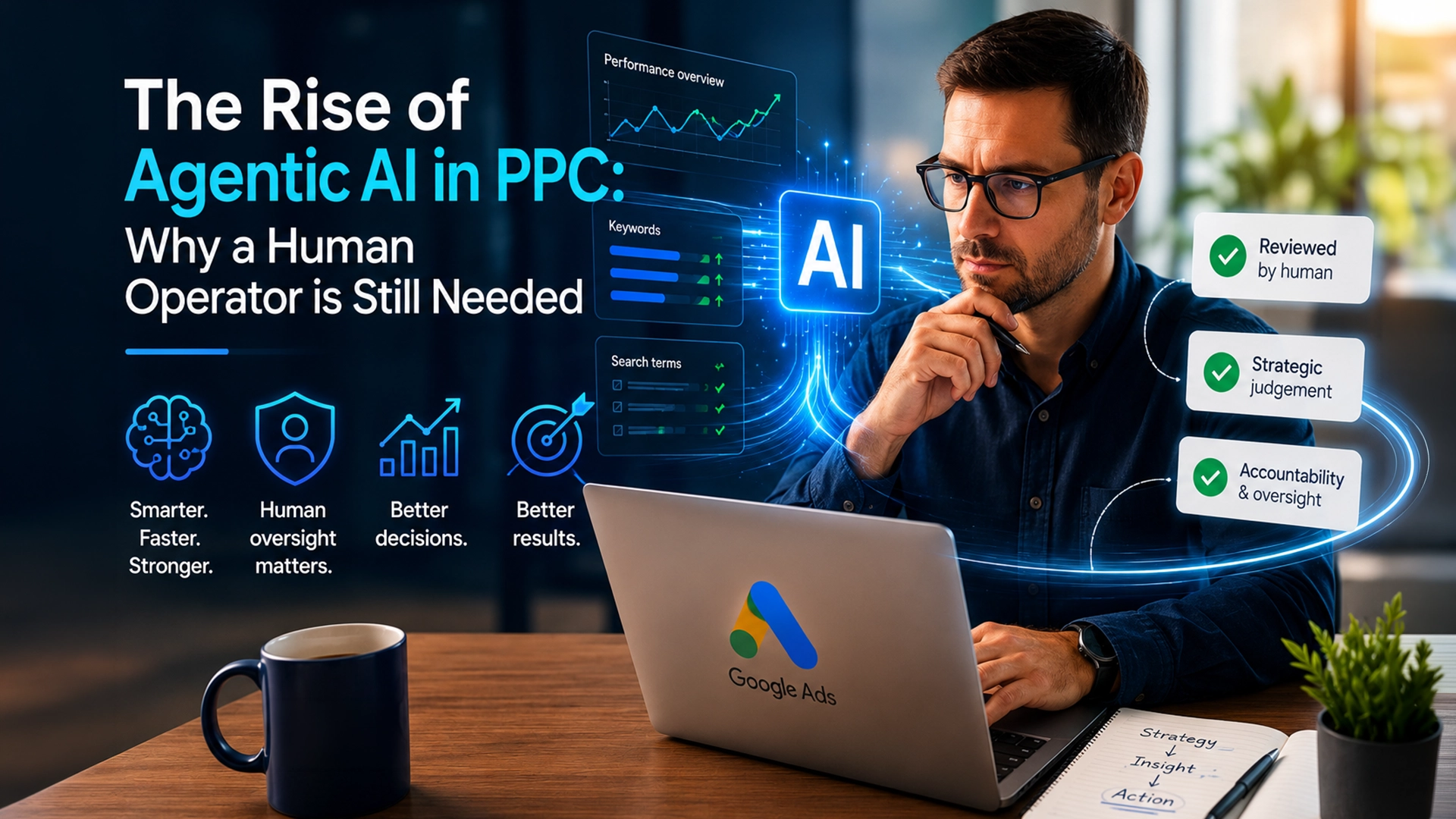
The mistake is treating “AI in PPC” as a binary, either you automate everything or you stay manual. That framing isn’t quite right. The useful mental model, and one I personally agree with, is to treat agents as fast paced, auditable junior analysts, not as a replacement for the senior judgment that decides what is worth running in the first place.
How We Use Agentic AI in PPC at Veritas
We source and run our own AI agents for PPC. They are genuinely powerful, and they do real work: surfacing wasted spend, flagging broken destination URLs, building new ad copy, structuring competitor and auction insights, drafting at speed.
But they build the work for us and then we review it. They do not act on a live account on their own. Every output goes through an experienced member of staff first. We QA it, we sense-check it against what we know about a client’s unit economics, legal requirements and preferences, and only make changes once we approve it. The agent does the heavy lifting; the judgment, the accountability, and the final click stay human first.
That is not me being cautious for the sake of it. It is the only model that gives you the speed of automation without the potential fire. Our approach is to treat a client’s budget as sacred, as if it’s our own money. And allowing an agent autonomous control over that, would be disastrous given it can misunderstand context.
This leads on to what I like to call the Human Operator + Agentic AI approach. The AI compresses the time it takes to find the opportunity. The human operator decides whether it is the right opportunity and carries the responsibility for the decision. You get the leverage of the machine and the protection of senior oversight. You do not get an account suspension, even if it’s a temporarily one, on a random Tuesday morning.
The Bottom Line
Agentic AI is one of the most genuinely useful shifts paid search/PPC has seen in years, and any agency claiming otherwise is not paying attention. But “autonomous” and “unsupervised” are not the same word, and the businesses learning that distinction the hard way are the ones who handed over the keys entirely.
If you want the upside of agentic AI applied to your accounts, with a human operator who has run multi-million-pound annual budgets sitting between the agent and your money, that is exactly what we at Veritas Digital do. You can read more about how we approach paid search on the PPC services page, or skip straight to getting in touch.
Get in touch with us
If agentic AI in your PPC accounts is something you are weighing up, whether you are excited by it or wary of it, I’m happy to chat to you more about it. Get in touch with us and we can work out the right level of automation for your brand or business.
References
- Agentic AI systems must have ‘a human in the loop,’ says Google exec – Fortune
- Will using MCP with my Meta Ads account get it suspended? – Blend AI
- Why AI agents are getting ad accounts banned and how to avoid it – Supermetrics
- Google’s Ask Advisor unifies ads, analytics, and commerce in one AI agent – PPC Land
- Google shares what’s next in digital advertising and commerce in 2026 – Search Engine Land
- groas introduces a fully autonomous approach to Google Ads management – Search Engine Land
- Agentic AI in Advertising: A 2026 Field Guide – TensorOps