
By Lee Moran, Founder of Veritas Digital
Every May, Google Marketing Live sets the tone for where paid search is heading, and this year the message was bigger than years before. Across two days on the 20th and 21st of May, almost every announcement pointed in the same direction: Gemini is no longer a feature bolted onto Google Ads, it is becoming the layer that everything else runs through.
If you run Google Ads for your business, that shift is worth understanding before it quietly changes how your account behaves. This article walks through what got announced, what it means in practice, and where I personally think you should lean in versus hold back. I will keep the jargon to a minimum and focus on the bits that affect your budget and your results, as us PPC’ers do love our PPC speak (I’ll save you from the details of this!).
The headline: Gemini becomes the operating system
In previous years, Google tended to announce features that lived in their own silos. One thing made creative easier, another made reporting richer, another tweaked bidding. This year the theme was joining them up. The stated goal is a single, a connected AI layer that follows a customer across Search, YouTube, Gmail, Maps and the Gemini app, rather than a set of disconnected tools.
For a business owner, the practical takeaway is this: the account is becoming more automated and more interconnected by default. That brings real upside in speed and reach. It also means the decisions Google makes on your behalf carry more weight, which makes the strategy and oversight sitting above the account matter more, not less.
Ask Advisor: one assistant across your whole stack
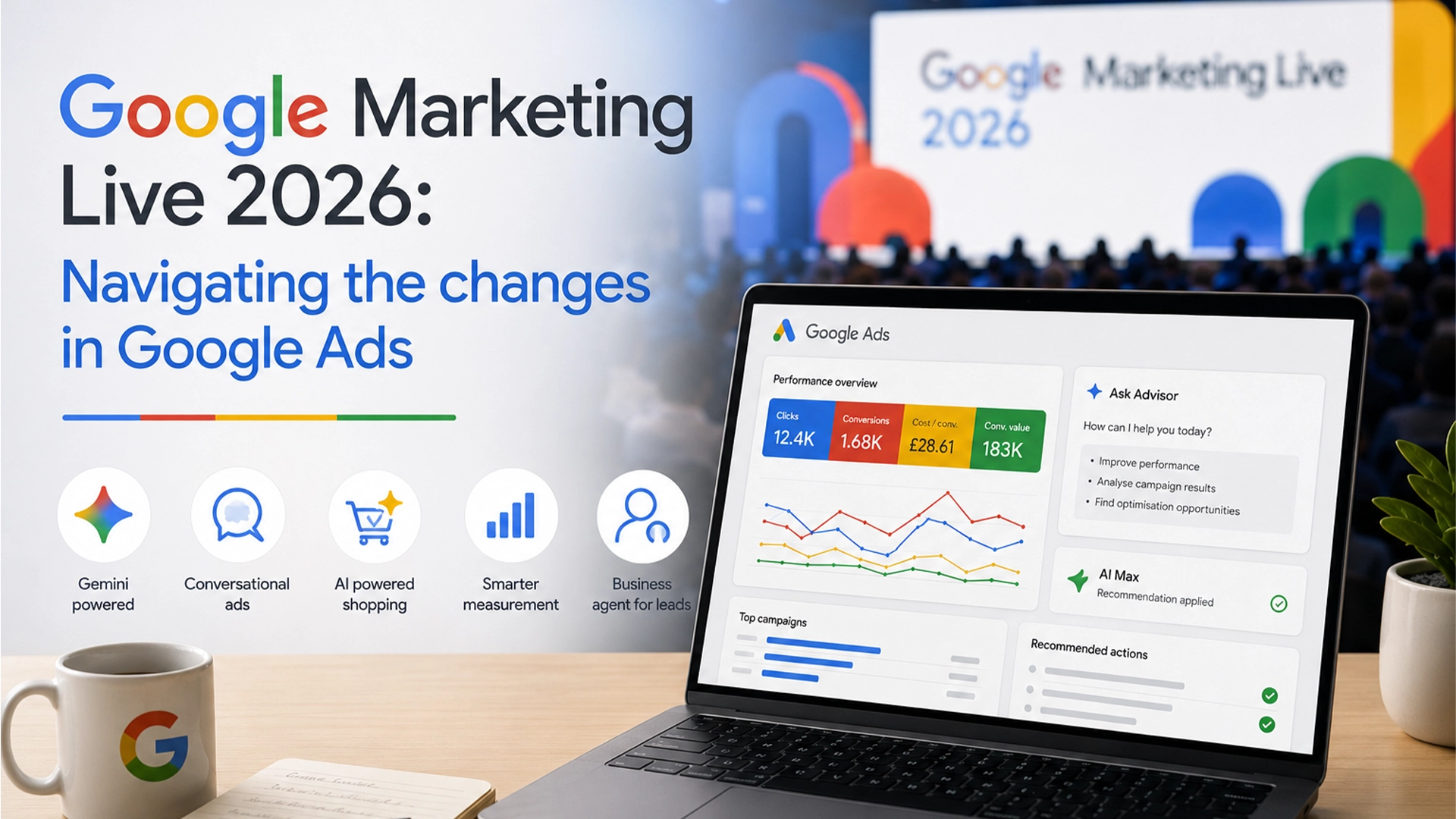
One of the biggest launches was Ask Advisor, a Gemini-powered assistant that spans Google Ads, Analytics, Merchant Centre and the Google Marketing Platform. The idea is a single collaborator that can help build campaigns, analyse performance, surface recommendations and handle operational tasks, pulling insights across products that used to live separately.
I for one welcome this. Anyone who has managed accounts for long enough will have hit the wall where Google Ads support and Analytics support do not quite speak the same language, because their teams specialise in one or the other.
A unified advisor that reasons across both is genuinely useful. The caveat is the same as ever: a recommendation is a starting point, not an instruction. Whether a suggested change is right for your margins and your goals is a judgement call, and that call should stay with a human who understands your business.
New AI-powered ad formats: ads are becoming conversations
Google announced a wave of Gemini powered formats built for AI Mode and conversational search, including Conversational Discovery ads, Highlighted Answers, AI powered Shopping ads and a Business Agent for Leads. The thread running through all of them is that ads are shifting from a single click toward an interactive, conversational experience embedded directly in the search journey.
This matters for two reasons. First, your ad copy and the answers your business gives are increasingly being surfaced inside an AI conversation, so the quality and clarity of your messaging carries more weight than ever. Second, if you operate in a regulated or sensitive sector, where the right wording is not optional, you will want a careful eye on what these formats are putting in front of customers on your behalf and that all creative is human reviewed.
AI Max, creative and Asset Studio
AI Max, Google’s AI driven campaign approach, turned one year old and was pushed hard, with Google citing meaningful conversion uplift for advertisers who adopt it. Alongside it, Asset Studio gained Gemini-powered creative generation, including images, video and text variations from natural-language prompts, plus one-click creative testing.
The opportunity here is real, particularly for businesses that have struggled to produce enough creative to test properly. The trade-off is control. AI Max leans on broad match and keywordless technology (similar to Pmax) to find queries you have not targeted, which can uncover genuine demand or quietly spend on traffic you would never have chosen. My advice is to test it deliberately, ring-fenced against your existing setup, rather than flipping everything over at once, as you may be in for a bit of a shock when you go through the search queries.
Measurement: Meridian and Qualified Future Conversions
On the measurement side, Google is bringing Meridian, its open-source marketing mix modelling library, directly into Analytics 360, and introduced Qualified Future Conversions, a predictive metric that tries to connect today’s ad activity with future revenue signals.
This is the announcement I would watch most closely as your business grows. Marketing mix modelling moving from a once a year exercise to something closer to a continuous input is a massive step forward. But predictive metrics are only as good as the data feeding them, and it becomes very easy to optimise toward a forecast rather than toward real revenue. Treat these as a useful lens, not gospel, and make sure someone is sense checking the inputs and most importantly, your financial accounts.
So how should we navigate all this?
If you read my last article on The Rise of Agentic AI in PPC, the throughline here will feel familiar. Google is handing advertisers more automation and more autonomy than ever, and the businesses that win will not be the ones who simply switch it all on, nor the ones who refuse to touch it. They will be the ones who adopt the genuinely useful parts deliberately, with a human keeping hold of the strategy, oversight and the spend allocation. The human is the captain, AI and automation is the ship.
The mistake is treating this as a binary, where you either automate everything or stay fully manual. Here is how the two approaches compare:
| Switch everything on | Adopt deliberately (the way we do it at Veritas) | |
| Who sets strategy | The platform’s defaults | You, with senior oversight on the account |
| Speed to adopt | All at once, account-wide | Tested in ring-fenced, controlled campaigns |
| Risk to budget | High; spend follows the machine | Managed; spend follows your goals |
| Recommendations | Treated as instructions | Treated as prompts for a human decision to review |
| Best at | Looking modern fast | Protecting margins and scaling properly |
In practice, that means a few simple principles:
- Adopt the tools that compress your workload, like creative generation and unified reporting, but keep a person reviewing and QA’ing the output before it goes live.
- Test the autonomous features, such as AI Max, in a controlled, ring fenced way rather than across the whole account at once (and monitor those search queries!).
- Treat every AI recommendation as a prompt to decide, not as the decision itself, especially where your margins or compliance are involved.
- Make sure someone owns the account who understands your unit economics, not just the platform’s dashboards. It’s important to scale services that contribute to margin, not just revenue or ROAS.
The bottom line
Google Marketing Live 2026 confirmed the direction of travel rather than surprising anyone: AI is now the default surface, not an add-on. That is a good thing for businesses willing to use it well. The risk is not the technology itself; it is handing over judgement along with the automation that AI is bringing.
Get in touch with us
If you want help working out which of these changes move the needle for your business, and which are noise, that is exactly the kind of thing we do at Veritas. You can read more about how we approach paid search on our PPC services page, or get in touch and we can talk more about it.
References
- Google Marketing Live 2026: Everything you need to know – Search Engine Land
- Google launches Ask Advisor across Ads, Analytics and Merchant Centre – Search Engine Land
- Google tests new conversational ad formats in AI Mode and Search – Search Engine Land
- Google brings Meridian marketing mix modelling into Analytics 360 – Search Engine Land
- Google’s latest AI ad push shows ads are becoming conversations, not clicks – Search Engine Land
- Google Marketing Live 2026: 11 Biggest Announcements – Word Stream
- See what we announced at Google Marketing Live 2026 – Google Ads Help